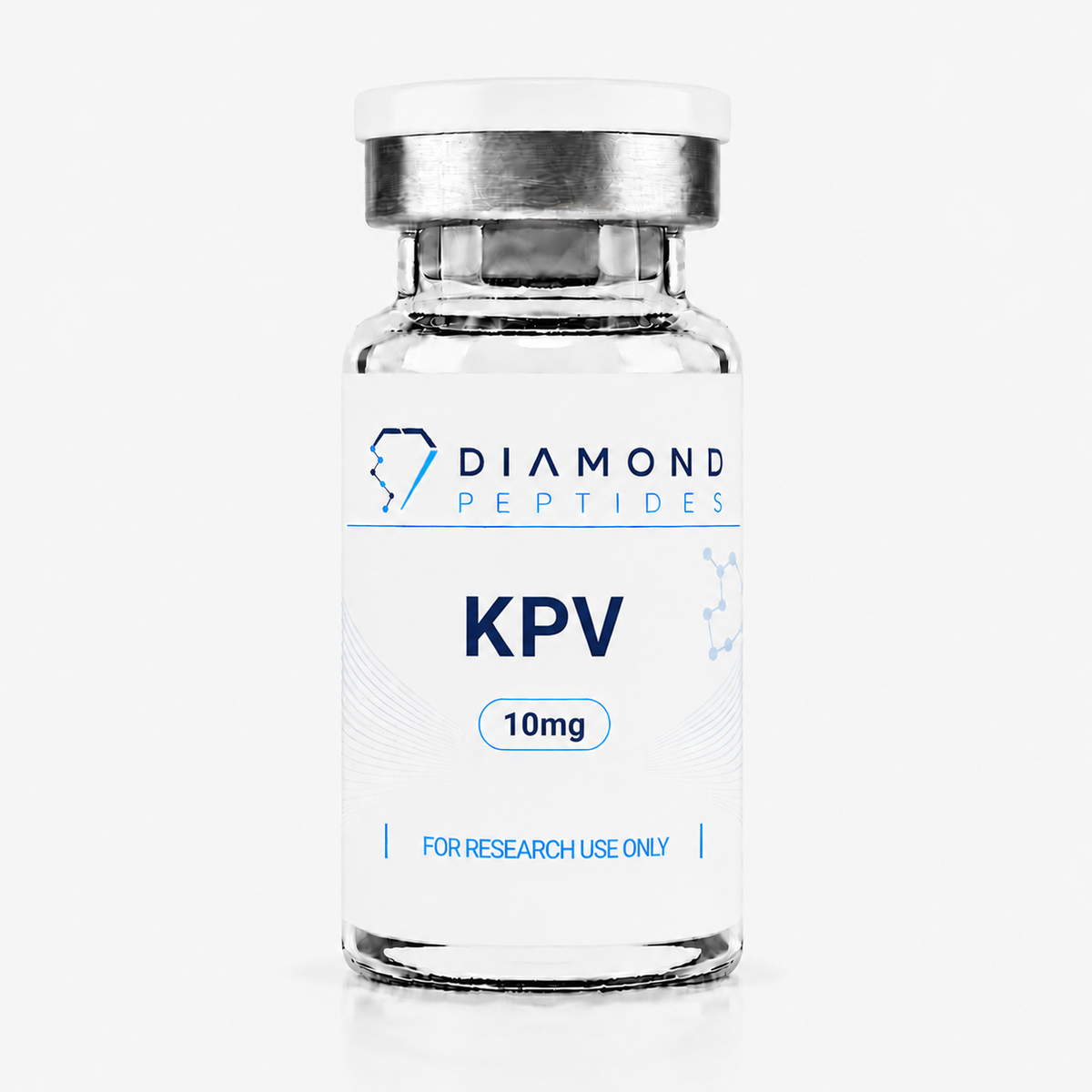
KPV
KPV
In stock
- Lab Tested for Purity & Quality
- Fast & Secure Shipping
- Manufactured in Canada
Couldn't load pickup availability
Buy KPV 10mg – Research Peptide
KPV is a short tripeptide consisting of the three amino acids lysine, proline, and valine. It corresponds to the C-terminal sequence of alpha-melanocyte-stimulating hormone (α-MSH) and has been investigated extensively in preclinical research involving inflammatory signaling, epithelial biology, cellular responses, and related molecular pathways.
Diamond Peptides KPV 10mg is supplied as a lyophilized research-grade peptide intended for laboratory and scientific research applications. The 10mg format provides researchers with a defined quantity of KPV for controlled experimental investigation and analytical work.
Product Details
- Form: Lyophilized peptide
- Net per vial: 10 mg
- Purity: ≥99% HPLC-verified
- Identity: MS-verified, per applicable Certificate of Analysis
- Sequence: Lys-Pro-Val (KPV)
- Formula: C16H24N4O5
- Molecular Weight: 336.39 g/mol
- Storage: Store according to the product-specific documentation and applicable laboratory handling requirements
- Research Use: For laboratory and scientific research applications only
What Makes KPV a Unique Compound?
KPV is a particularly small peptide consisting of only three amino acids: lysine-proline-valine. It represents the C-terminal tripeptide sequence of α-MSH, a peptide hormone involved in several biological signaling pathways.
The small size and defined sequence of KPV make it useful as a research compound for investigating peptide-mediated cellular signaling without requiring the complete α-MSH peptide.
Preclinical research has examined KPV in several experimental systems, including models involving inflammatory signaling and epithelial biology. Research has explored its interactions with pathways associated with inflammatory responses, cellular signaling, and barrier-related processes.
KPV has also attracted scientific interest because its biological activity can be investigated independently from the larger α-MSH molecule. This makes it a useful compound for researchers studying the relationship between short peptide sequences and specific biological responses.
KPV should be understood as a defined three-amino-acid peptide rather than simply as a shortened version of α-MSH. Its small molecular structure provides researchers with an opportunity to investigate the biological characteristics associated with this specific sequence.
Key Benefits
- Defined Three-Amino-Acid Sequence: KPV consists of the precisely defined Lys-Pro-Val sequence, making it a straightforward compound for controlled peptide research.
- α-MSH-Derived Peptide: KPV corresponds to the C-terminal tripeptide sequence of alpha-melanocyte-stimulating hormone and provides a useful research model for studying short peptide sequences derived from larger signaling molecules.
- Inflammatory Signaling Research: KPV has been investigated in preclinical research examining molecular pathways associated with inflammatory responses.
- Epithelial Biology Research: Experimental research has investigated KPV in models involving epithelial cells and related biological processes.
- Cellular Signaling Studies: Its defined structure makes KPV suitable for laboratory research examining peptide-mediated cellular signaling and molecular responses.
- Research-Grade 10mg Format: Supplied as a lyophilized 10mg preparation for controlled laboratory research applications.
- Analytical Quality: Product specifications are supported by analytical testing, including HPLC purity analysis and mass-spectrometry-based identity confirmation where applicable.
Research Applications
KPV can be investigated in controlled laboratory research examining peptide signaling, inflammatory pathways, epithelial biology, and related molecular processes.
- Inflammatory signaling research: Investigation of cellular and molecular pathways associated with inflammatory responses.
- Epithelial cell research: Experimental studies involving epithelial cell biology and associated signaling pathways.
- Cellular signaling studies: Investigation of peptide-mediated signaling mechanisms and downstream cellular responses.
- Peptide sequence research: Study of the biological characteristics associated with short peptide sequences derived from larger signaling molecules.
- α-MSH-related research: Investigation of the C-terminal sequence of α-MSH and its associated biological characteristics.
- Inflammation model research: Use in appropriate preclinical or in-vitro experimental models examining inflammatory responses.
- Structure-function studies: Investigation of relationships between peptide sequence, molecular structure, and observed experimental responses.
- Comparative peptide research: Comparison of KPV with related peptides or peptide sequences in controlled experimental systems.
Related Research Peptides
- GHK-Cu – Copper-binding peptide investigated in cellular and extracellular matrix research.
- BPC-157 – Synthetic peptide widely investigated in preclinical research.
- TB-500 – Research peptide associated with thymosin beta-4-related biological research.
- MOTS-c – Mitochondrial-derived peptide investigated in cellular and metabolic research.
- Browse All Research Peptides
Frequently Asked Questions
What is KPV?
KPV is a short tripeptide consisting of the amino acids lysine, proline, and valine. The sequence is Lys-Pro-Val (KPV) and corresponds to the C-terminal region of alpha-melanocyte-stimulating hormone (α-MSH).
What does KPV stand for?
KPV refers to the three amino acids that make up the peptide sequence: K for lysine, P for proline, and V for valine. The sequence is therefore commonly written as Lys-Pro-Val or KPV.
How many milligrams are in the KPV vial?
Each Diamond Peptides KPV vial contains 10mg of lyophilized KPV peptide.
What is the molecular weight of KPV?
The molecular weight of KPV is approximately 336.39 g/mol. Its relatively small molecular size reflects its composition as a three-amino-acid peptide.
What is the amino-acid sequence of KPV?
The sequence of KPV is Lys-Pro-Val, commonly abbreviated as KPV.
What is KPV derived from?
KPV corresponds to the C-terminal tripeptide sequence of alpha-melanocyte-stimulating hormone (α-MSH). Researchers have investigated the biological properties of this short peptide independently from the larger α-MSH molecule.
What is KPV researched for?
KPV has been investigated primarily in preclinical and laboratory research involving inflammatory signaling, epithelial biology, cellular responses, and related molecular pathways. These studies are experimental and should not be interpreted as evidence of established human therapeutic effects.
Is KPV a naturally occurring peptide?
KPV is a sequence derived from α-MSH, a naturally occurring peptide hormone. Research-grade KPV supplied as a laboratory material is a defined synthetic peptide corresponding to the Lys-Pro-Val sequence.
How is KPV tested?
KPV can be characterized using analytical techniques such as high-performance liquid chromatography (HPLC) and mass spectrometry (MS). HPLC can be used to evaluate chromatographic purity, while MS can provide molecular-mass information supporting peptide identity. Applicable batch documentation should be consulted for specific analytical results.
What does ≥99% HPLC purity mean for KPV?
A reported HPLC purity of ≥99% indicates that the principal chromatographic component accounts for at least approximately 99% of the integrated chromatographic signal under the specified analytical method. It does not independently establish complete molecular identity, pharmaceutical-grade quality, or the absence of every possible impurity.
Is KPV intended for human use?
No. Diamond Peptides KPV is supplied strictly as a research-grade material for laboratory and scientific research purposes. It is not represented as a drug, dietary supplement, or product intended for human or veterinary administration.
How should KPV be stored?
KPV should be stored according to the product-specific storage instructions and applicable laboratory handling procedures. Researchers should consult the accompanying documentation for appropriate storage conditions and maintain suitable controls throughout storage and handling.
Is KPV included in KLOW Blend?
Yes. KPV is one of the four peptide components in KLOW Blend. The KLOW formulation contains 10mg BPC-157, 10mg TB-500, 50mg GHK-Cu, and 10mg KPV per vial. Researchers interested in the defined multi-peptide formulation can learn more about KLOW Blend.
⚠️ For research use only. Not intended for human or veterinary use. Not a drug, food, or supplement.