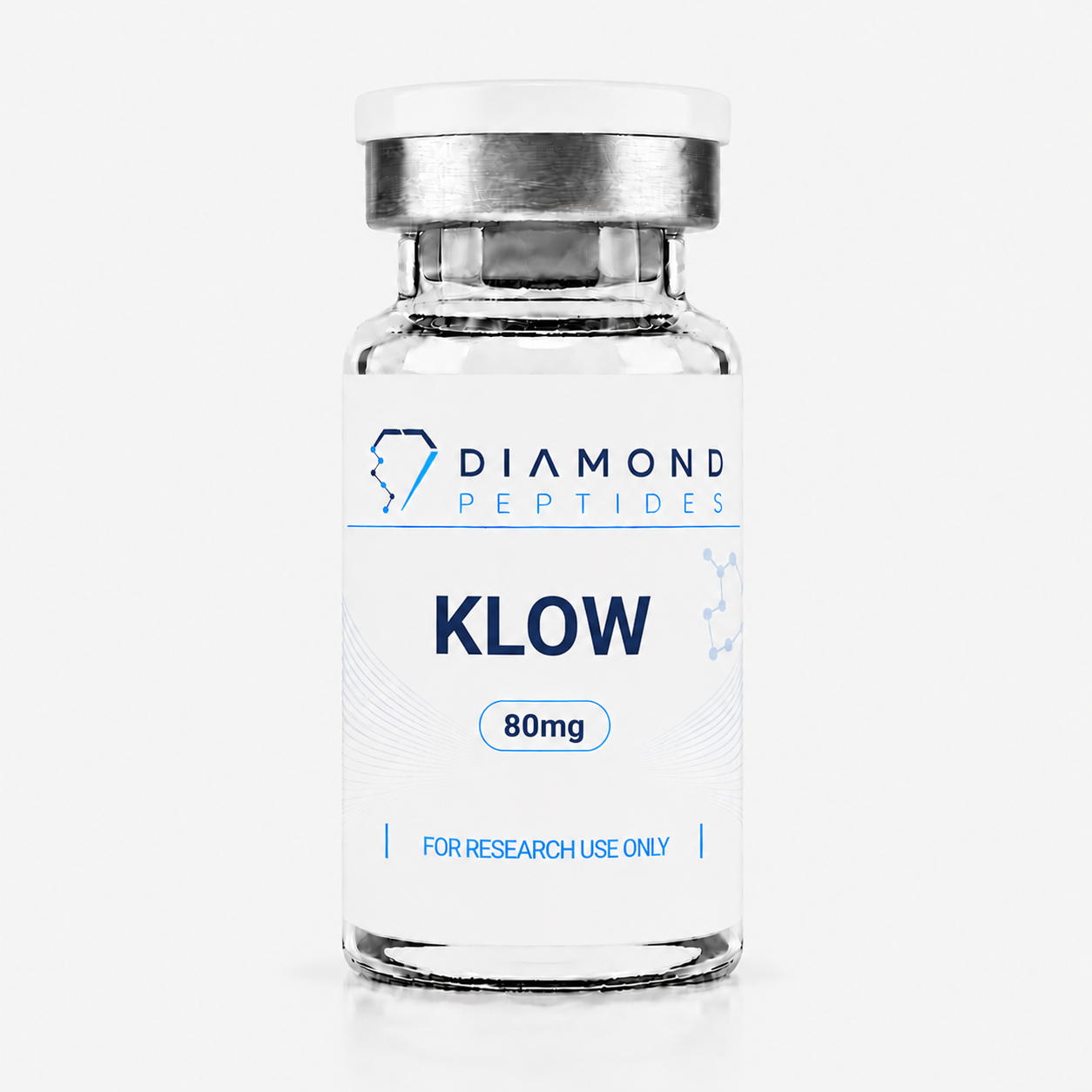
KLOW Blend (BPC-157 + TB-500 + GHK-Cu + KPV)
KLOW Blend (BPC-157 + TB-500 + GHK-Cu + KPV)
In stock
- Lab Tested for Purity & Quality
- Fast & Secure Shipping
- Manufactured in Canada
Couldn't load pickup availability
Buy KLOW Blend (BPC-157 + TB-500 + GHK-Cu + KPV)
KLOW Blend is a multi-peptide research formulation combining BPC-157, TB-500, GHK-Cu, and KPV into a single research-oriented preparation. The blend contains 10 mg of BPC-157, 10 mg of TB-500, 50 mg of GHK-Cu, and 10 mg of KPV, providing 80 mg of total peptide material per vial.
Each component of KLOW Blend has been investigated independently in preclinical and laboratory research, with the four compounds representing distinct areas of peptide research. Combining them into a single formulation provides researchers with a convenient material for studying the potential interactions and complementary biological characteristics of these compounds within controlled experimental systems.
Product Details
- Form: Lyophilized peptide blend
- Net per vial: 80 mg total peptide material
- Formula: BPC-157 10 mg / TB-500 10 mg / GHK-Cu 50 mg / KPV 10 mg
- Purity: ≥99% HPLC-verified
- Identity: MS-verified
- Storage: Store according to the accompanying product documentation and applicable laboratory handling requirements
- Research Use: For laboratory and scientific research applications only
What Makes KLOW Blend a Unique Research Compound?
KLOW Blend is distinguished by its combination of four structurally and functionally different peptides: BPC-157, TB-500, GHK-Cu, and KPV.
Rather than representing a single-peptide research material, the formulation provides researchers with a defined multi-component system. Each peptide can be studied independently, while the combined formulation can be used to investigate how multiple peptide compounds behave within the same experimental model.
BPC-157 is a synthetic peptide that has been investigated extensively in preclinical research, particularly in experimental models examining cellular signaling, tissue biology, and gastrointestinal-related processes.
TB-500 is a research peptide associated with the naturally occurring thymosin beta-4 sequence and has been investigated in experimental research involving cellular migration, cytoskeletal processes, angiogenesis, and tissue biology.
GHK-Cu is a copper-binding peptide complex that has been studied extensively in research involving extracellular matrix biology, collagen-related processes, cellular signaling, and skin and tissue biology.
KPV is a short peptide derived from the C-terminal sequence of alpha-melanocyte-stimulating hormone (α-MSH). Research involving KPV has investigated inflammatory signaling, epithelial biology, and related cellular pathways.
The combination of these four compounds creates a distinct research formulation that can be evaluated as a multi-peptide system rather than as four unrelated materials.
Key Benefits
- Multi-Peptide Research Formulation: Combines BPC-157, TB-500, GHK-Cu, and KPV into a single defined research preparation.
- Four Distinct Research Compounds: Each peptide has an independent body of preclinical and laboratory research, allowing the blend to be investigated across multiple biological pathways.
- Defined 80 mg Composition: Each vial contains a specified 10/10/50/10 mg distribution of BPC-157, TB-500, GHK-Cu, and KPV respectively.
- Complementary Research Characteristics: The four components have been investigated in different areas of cellular, tissue, inflammatory, and extracellular-matrix research.
- Convenient Research Format: A multi-component preparation can simplify experimental designs where researchers specifically want to evaluate the four compounds together.
- Analytical Quality: Product specifications are supported by analytical testing, including HPLC purity analysis and mass-spectrometry-based identity confirmation where applicable.
Research Applications
KLOW Blend can be investigated in controlled laboratory research involving the biological characteristics of its individual peptide components and their combined presence within an experimental system.
- Cellular signaling research: Investigation of peptide-mediated cellular signaling pathways and downstream responses.
- Tissue biology: Experimental investigation of cellular and molecular processes associated with tissue structure and remodeling.
- Extracellular matrix research: Study of pathways associated with extracellular matrix proteins, collagen biology, and cellular-matrix interactions.
- Inflammatory signaling research: Investigation of molecular pathways associated with inflammatory signaling and cellular responses.
- Cell migration studies: Experimental research examining cellular migration and related signaling mechanisms.
- Peptide combination studies: Investigation of how multiple peptide compounds behave when evaluated together within controlled experimental models.
- Comparative peptide research: Comparison of the KLOW formulation with individual peptide components or other defined peptide combinations.
- In-vitro research: Laboratory investigation of peptide interactions and biological signaling using appropriate experimental models.
Related Research Peptides
- BPC-157 – Synthetic peptide investigated extensively in preclinical research.
- TB-500 – Research peptide associated with thymosin beta-4-related biological research.
- GHK-Cu – Copper-binding peptide studied in extracellular matrix and cellular biology research.
- KPV – Short peptide investigated in inflammatory and cellular research.
Frequently Asked Questions
What is KLOW Blend?
KLOW Blend is a defined four-peptide research formulation containing BPC-157, TB-500, GHK-Cu, and KPV. The formulation contains 10 mg of BPC-157, 10 mg of TB-500, 50 mg of GHK-Cu, and 10 mg of KPV per vial, for 80 mg of total peptide material.
What peptides are in KLOW Blend?
KLOW Blend contains four research peptides: BPC-157, TB-500, GHK-Cu, and KPV. The formulation ratio is 10 mg BPC-157, 10 mg TB-500, 50 mg GHK-Cu, and 10 mg KPV per vial.
How much peptide is in each KLOW Blend vial?
Each vial contains 80 mg of total peptide material, consisting of 10 mg BPC-157, 10 mg TB-500, 50 mg GHK-Cu, and 10 mg KPV.
Why does KLOW Blend contain more GHK-Cu than the other peptides?
The formulation uses a defined 10/10/50/10 mg composition, with GHK-Cu representing the largest mass fraction of the blend. This is a formulation characteristic and should not be interpreted as indicating that GHK-Cu is inherently more potent or biologically important than the other components.
Is KLOW Blend the same as BPC-157?
No. BPC-157 is a single-peptide research material, whereas KLOW Blend is a multi-peptide formulation containing BPC-157 together with TB-500, GHK-Cu, and KPV.
What is BPC-157 researched for?
BPC-157 has been investigated primarily in preclinical research examining cellular signaling, tissue biology, gastrointestinal-related processes, and other experimental biological systems. Findings from preclinical research should not automatically be interpreted as evidence of human clinical efficacy.
What is TB-500 researched for?
TB-500 is associated with research involving thymosin beta-4-related biological processes. Experimental studies have investigated areas including cellular migration, cytoskeletal organization, angiogenesis, and tissue biology.
What is GHK-Cu researched for?
GHK-Cu is a copper-binding peptide that has been investigated in research involving extracellular matrix biology, collagen-related processes, cellular signaling, and tissue and skin biology.
What is KPV researched for?
KPV is a short peptide derived from the C-terminal region of α-MSH. Research has investigated KPV in relation to inflammatory signaling, epithelial biology, and related cellular pathways.
Is KLOW Blend intended for human use?
No. KLOW Blend is supplied strictly as a research-grade material for laboratory and scientific research purposes. It is not represented as a drug, dietary supplement, or product intended for human or veterinary administration.
How is KLOW Blend tested?
Analytical testing can include techniques such as HPLC for chromatographic purity assessment and mass spectrometry for molecular identity confirmation. The specific analytical results and specifications should be reviewed on the applicable batch documentation or Certificate of Analysis.
What does ≥99% HPLC purity mean for KLOW Blend?
A reported HPLC purity of ≥99% refers to the chromatographic purity measurement obtained under the specified analytical method. It should not be interpreted as proof that every component has been completely characterized or that the material meets pharmaceutical-grade standards. For a detailed explanation, see our guide to Understanding HPLC Testing: A Complete Guide to Peptide Purity Analysis.
How should KLOW Blend be stored?
KLOW Blend should be stored according to the product-specific storage instructions and applicable laboratory handling procedures. Researchers should consult the accompanying documentation for the appropriate conditions for the material and maintain appropriate controls throughout storage and handling.
⚠️ For research use only. Not intended for human or veterinary use. Not a drug, food, or supplement.