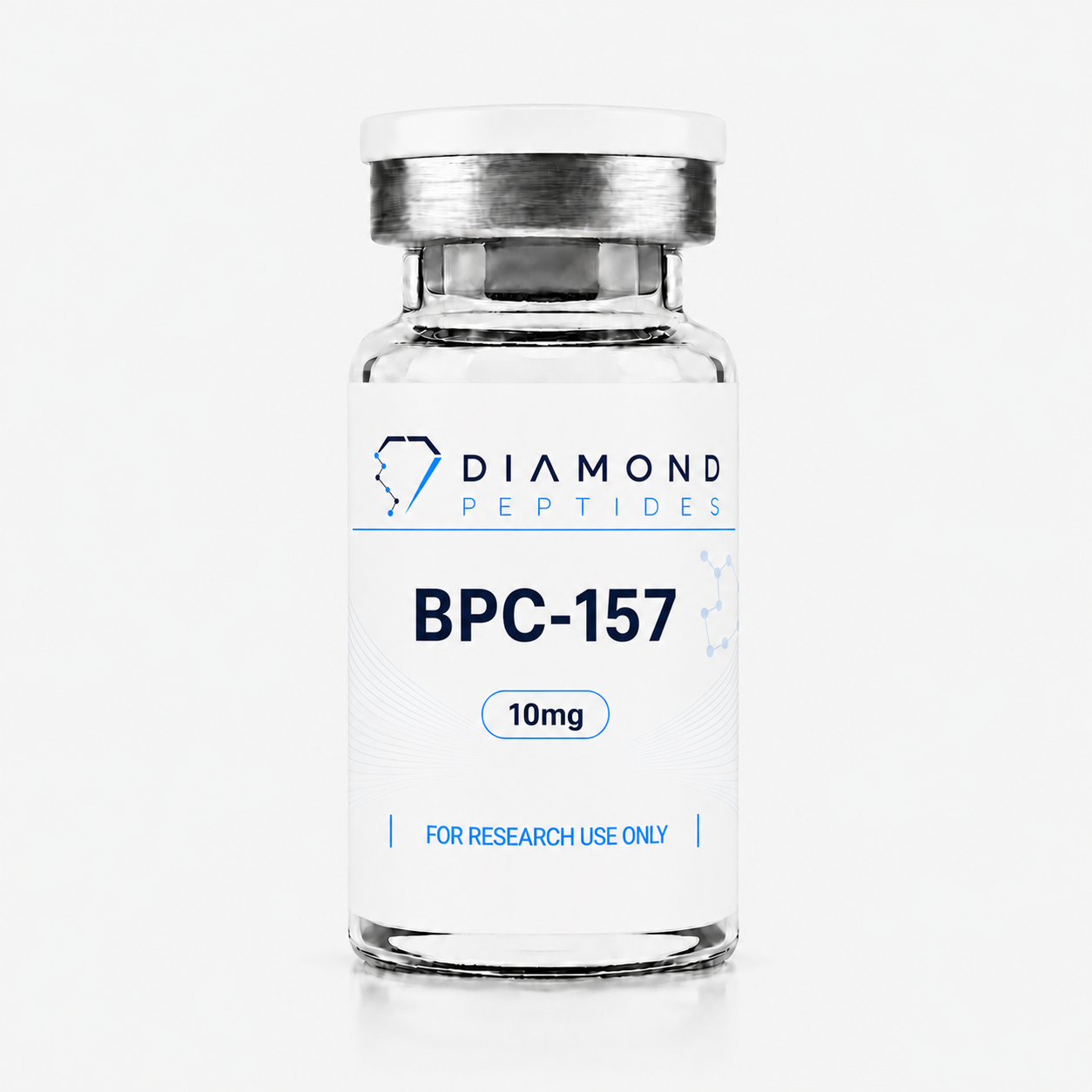
BPC-157 (4-Pack)
BPC-157 (4-Pack)
In stock
- Lab Tested for Purity & Quality
- Fast & Secure Shipping
- Manufactured in Canada
Couldn't load pickup availability
Buy BPC-157 in Canada | Research-Grade Tissue Repair Peptide
Diamond Peptides supplies premium-quality BPC-157 to laboratories, academic institutions, contract research organizations, and wholesale distributors across Canada. Every vial contains research-grade lyophilized peptide manufactured under rigorous quality standards and verified through High-Performance Liquid Chromatography (HPLC) purity analysis together with Mass Spectrometry (MS) identity confirmation.
BPC-157 is a synthetic pentadecapeptide consisting of 15 amino acids derived from a protective protein originally identified within gastric juice. The peptide has become one of the most extensively studied compounds in tissue-repair research, with published investigations spanning connective tissue, vascular biology, gastrointestinal integrity, and regenerative signalling. Whether supporting university research or commercial laboratory programs, Diamond Peptides provides dependable Canadian-manufactured peptides backed by consistent quality, batch-specific Certificates of Analysis (COAs), and reliable inventory.
Product Details
- Form: Lyophilized peptide
- Net per vial: 10 mg (filled to approximately 104% of label)
- Purity: ≥99% (HPLC-verified)
- Identity: MS-verified (per COA)
- Storage: 2–8 °C, protect from light
- Formula / M.W.: C62H98N16O22 / 1419.55 Da
- CAS: 137525-51-0
What Makes BPC-157 a Unique Compound
BPC-157, commonly referred to as the Body Protection Compound, has attracted significant scientific interest because of the diversity of biological systems in which it has been investigated. The peptide sequence originates from a naturally occurring protective protein identified in gastric juice and was first characterized through research led by Professor Predrag Sikirić and colleagues at the University of Zagreb. Since then, BPC-157 has become a widely recognized reference compound in regenerative medicine and tissue biology research.
Unlike many peptides that are primarily associated with a single physiological pathway, BPC-157 has been examined across numerous experimental models involving connective tissue, gastrointestinal integrity, vascular function, and cellular repair mechanisms. Published studies suggest that these diverse research applications may be linked to its interactions with angiogenic signalling, nitric oxide pathways, and multiple growth-factor networks involved in tissue regeneration. This broad research profile has made BPC-157 one of the most frequently selected peptides for investigators studying repair-related biological processes.
Another distinguishing characteristic of BPC-157 is its reported stability under laboratory conditions compared with many naturally occurring peptide hormones. This stability, combined with its extensive presence throughout the scientific literature, has established the compound as a valuable experimental reference for researchers seeking reproducible investigations involving healing, cellular communication, and regenerative biology.
For Canadian laboratories, BPC-157 provides a well-characterized research peptide supported by decades of published investigation across multiple fields of study. Its versatility allows researchers to examine several interconnected biological pathways using a single, extensively documented experimental compound.
Key Benefits
- Tissue Repair Research — BPC-157 is widely investigated in experimental models evaluating connective tissue regeneration, including studies involving soft tissue recovery, collagen organization, and cellular repair processes.
- Angiogenesis & Vascular Biology — Scientific research has explored the peptide's influence on new blood vessel formation and vascular signalling, making it an important reference compound in angiogenesis-related investigations.
- Gastrointestinal Integrity — Much of the foundational literature surrounding BPC-157 focuses on gastrointestinal models, where researchers have examined its relationship with mucosal protection and tissue maintenance.
- Tendon & Ligament Models — BPC-157 is frequently incorporated into laboratory studies investigating tendon and ligament biology, including cellular behaviour, extracellular matrix organization, and connective tissue adaptation.
- Growth Factor Signalling — Researchers continue to examine BPC-157 for its potential interactions with growth-factor pathways involved in tissue repair, cellular communication, and regenerative processes.
- Nitric Oxide Pathway Research — Experimental studies have explored the peptide's relationship with nitric oxide signalling, an area of interest due to its role in vascular function and tissue physiology.
Related Research Peptides
Researchers studying BPC-157 frequently evaluate it alongside other research peptides involved in tissue regeneration, cellular repair, and metabolic biology. Common companion compounds include:
- TB-500 — A thymosin beta-4 analogue commonly investigated for its role in cell migration, tissue regeneration, and connective tissue research.
- GHK-Cu — A naturally occurring copper-binding tripeptide widely studied for extracellular matrix remodelling, collagen biology, and wound-healing research.
- Wolverine Stack — A research peptide combination frequently selected by laboratories investigating complementary tissue-repair pathways using multiple experimental compounds.
- Retatrutide — Although primarily studied in metabolic research, Retatrutide is sometimes evaluated alongside BPC-157 in broader investigations involving liver biology, lipid metabolism, and regenerative physiology.
Frequently Asked Questions
Where can I buy BPC-157 in Canada for laboratory research?
Diamond Peptides supplies research-grade BPC-157 exclusively for scientific and laboratory use throughout Canada. Every production batch is accompanied by batch-specific documentation, including HPLC purity verification, MS identity confirmation, and a Certificate of Analysis (COA) to support research quality assurance.
How does BPC-157 differ from TB-500?
Although both peptides are commonly investigated in tissue-repair research, they originate from different biological sources and have distinct areas of scientific interest. BPC-157 is derived from a protective gastric protein sequence and is frequently studied in angiogenesis and gastrointestinal models, whereas TB-500 is based on thymosin beta-4 and is widely investigated for its role in cell migration and connective tissue biology.
Is BPC-157 naturally occurring?
BPC-157 is a synthetic research peptide modeled after a sequence identified within a naturally occurring protective protein found in gastric juice. The material supplied for laboratory research is chemically synthesized under controlled manufacturing conditions and is not isolated directly from biological tissue.
How are purity and identity verified?
Each production lot undergoes High-Performance Liquid Chromatography (HPLC) testing to verify a purity of at least 99%, while Mass Spectrometry (MS) is used to confirm molecular identity. Batch-specific Certificates of Analysis are provided to support quality control and research documentation.
⚠️ For research use only. Not intended for human or veterinary use. Not a drug, food, or supplement.