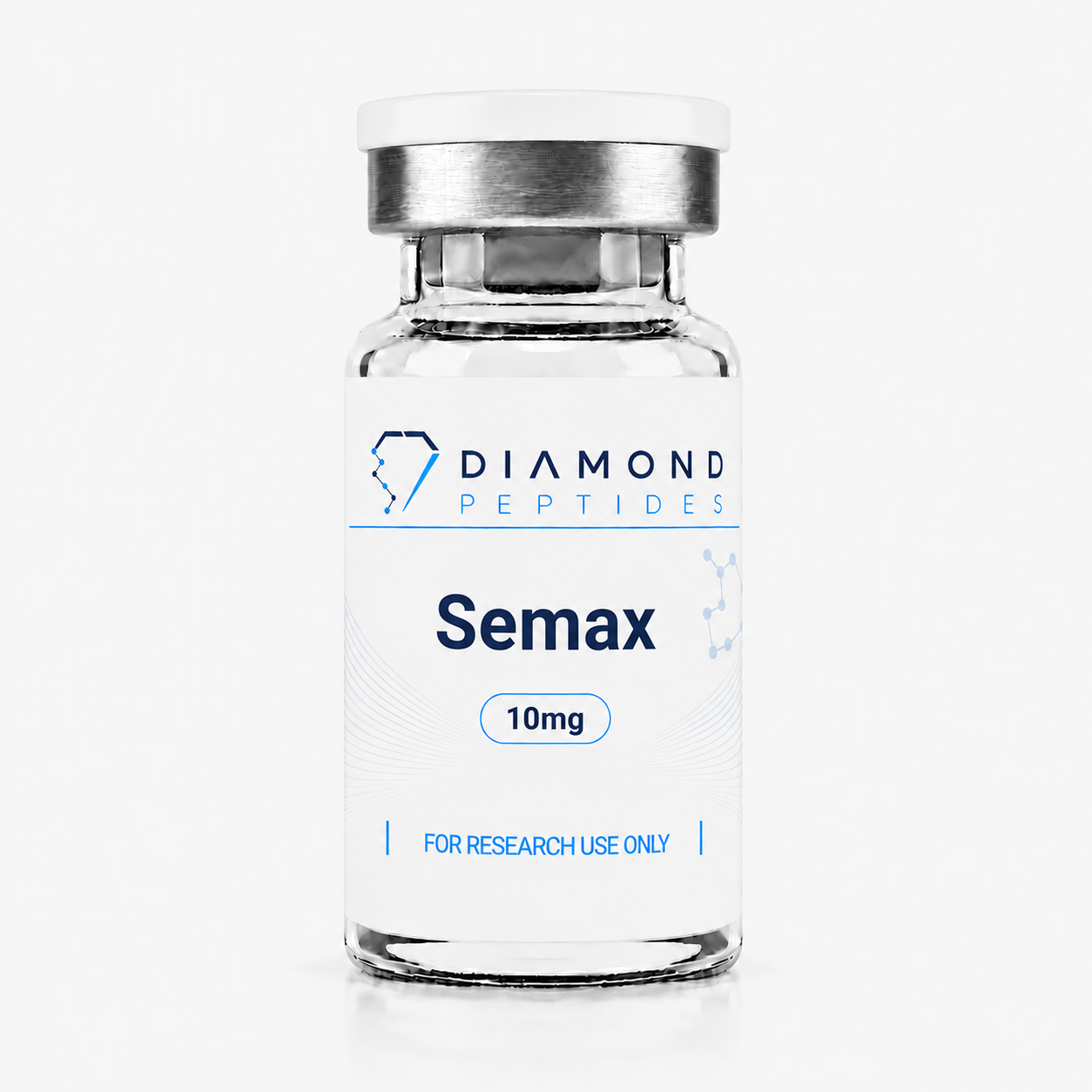
Semax (4-Pack)
Semax (4-Pack)
In stock
- Lab Tested for Purity & Quality
- Fast & Secure Shipping
- Manufactured in Canada
Couldn't load pickup availability
Product Details
- Form: Lyophilized peptide
- Net per vial: 10 mg (filled to approximately 104% of label)
- Purity: ≥99% (HPLC-verified)
- Identity: MS-verified (per COA)
- Storage: 2–8 °C, protect from light
- Formula / M.W.: C37H51N9O10S / 813.92 Da
- CAS: 80714-61-0
What Makes Semax a Unique Compound
Semax is a synthetic peptide originally developed from the ACTH (4–10) fragment and subsequently modified to improve stability while eliminating the endocrine activity associated with the parent hormone. These structural modifications transformed Semax into a research peptide focused on neurological investigation rather than hormonal regulation, making it a unique tool within modern neuroscience research.
Scientific literature has extensively explored Semax for its relationship with neurotrophic signalling pathways, particularly those involving brain-derived neurotrophic factor (BDNF) and other proteins associated with neuronal development and plasticity. Researchers have also investigated the peptide in studies involving learning, memory, cognitive performance, and neuroprotection, contributing to its reputation as one of the best-characterized nootropic research peptides.
Unlike many neuroactive compounds that directly target neurotransmitter receptors, Semax is primarily investigated for its influence on broader signalling networks involved in neuronal adaptation and cellular resilience. This distinctive mechanism has led to widespread interest in experimental models examining neural stress, cognitive function, and neuroplasticity.
For Canadian laboratories studying neuroscience and cognitive biology, Semax provides a well-characterized research peptide supported by decades of published scientific investigation. It is frequently evaluated alongside related compounds such as Selank to compare complementary mechanisms involved in neuropeptide signalling and cognitive research.
Key Benefits
- Cognitive Function Research — Semax is widely investigated in laboratory models examining learning, memory, attention, and other cognitive processes associated with higher neurological function.
- Neurotrophic Signalling — Scientific literature has extensively explored Semax for its relationship with brain-derived neurotrophic factor (BDNF) and other signalling molecules involved in neuronal growth and plasticity.
- Neuroprotection Research — Researchers continue to investigate Semax in experimental models involving neuronal resilience, oxidative stress, and protective mechanisms within the central nervous system.
- Neuroplasticity Studies — Semax is frequently investigated for its influence on the biological pathways involved in synaptic plasticity, neuronal adaptation, and long-term changes in brain function.
- Comparative Nootropic Research — Because of its distinctive neurotrophic mechanism, Semax is commonly studied alongside other nootropic peptides to compare their effects on cognitive and neurological signalling pathways.
- Neuroscience Research — By supporting investigations into neuronal signalling, neurotrophic factors, and cognitive biology, Semax has become one of the most extensively studied synthetic peptides within modern neuroscience research.
Related Research Peptides
Researchers investigating Semax frequently study it alongside other compounds involved in neuroscience, cognitive function, and cellular metabolism. Common companion peptides include:
- Selank — A synthetic peptide developed from the same research program as Semax, widely investigated for neuropeptide signalling, cognitive biology, and complementary neurological pathways.
- NAD+ — A naturally occurring coenzyme extensively studied for mitochondrial function, cellular energy production, and neuronal metabolism, making it a complementary compound in neuroscience research.
- Retatrutide — A next-generation metabolic research peptide that may be included in broader investigations exploring interactions between metabolic physiology and neurological function.
- MOTS-c — A mitochondrial-derived peptide commonly investigated for cellular metabolism, mitochondrial signalling, and energy regulation, providing an additional perspective in studies involving neuronal physiology.
Frequently Asked Questions
Where can I buy Semax in Canada for laboratory research?
Diamond Peptides supplies research-grade Semax exclusively for scientific and laboratory research throughout Canada. Every production batch undergoes High-Performance Liquid Chromatography (HPLC) purity verification, Mass Spectrometry (MS) identity confirmation, and is supported by batch-specific Certificates of Analysis (COAs).
How is Semax different from Selank?
Although both peptides originated from the same research program and are commonly investigated in neuroscience, they are studied for different biological pathways. Semax is primarily investigated for neurotrophic signalling, BDNF-related pathways, and cognitive function, whereas Selank is more frequently researched for neuropeptide signalling, immunomodulatory biology, and mechanisms associated with stress-related pathways.
Is Semax naturally occurring?
No. Semax is a synthetic peptide engineered from the ACTH (4–10) fragment. Structural modifications improve stability while eliminating the endocrine activity of the parent hormone, allowing researchers to focus on neurological and cognitive mechanisms.
How are purity and identity verified?
Every production lot is analyzed using High-Performance Liquid Chromatography (HPLC) to verify a purity of at least 99%, while Mass Spectrometry (MS) confirms molecular identity. Batch-specific Certificates of Analysis are provided to support laboratory quality assurance and research documentation.
⚠️ For research use only. Not intended for human or veterinary use. Not a drug, food, or supplement.