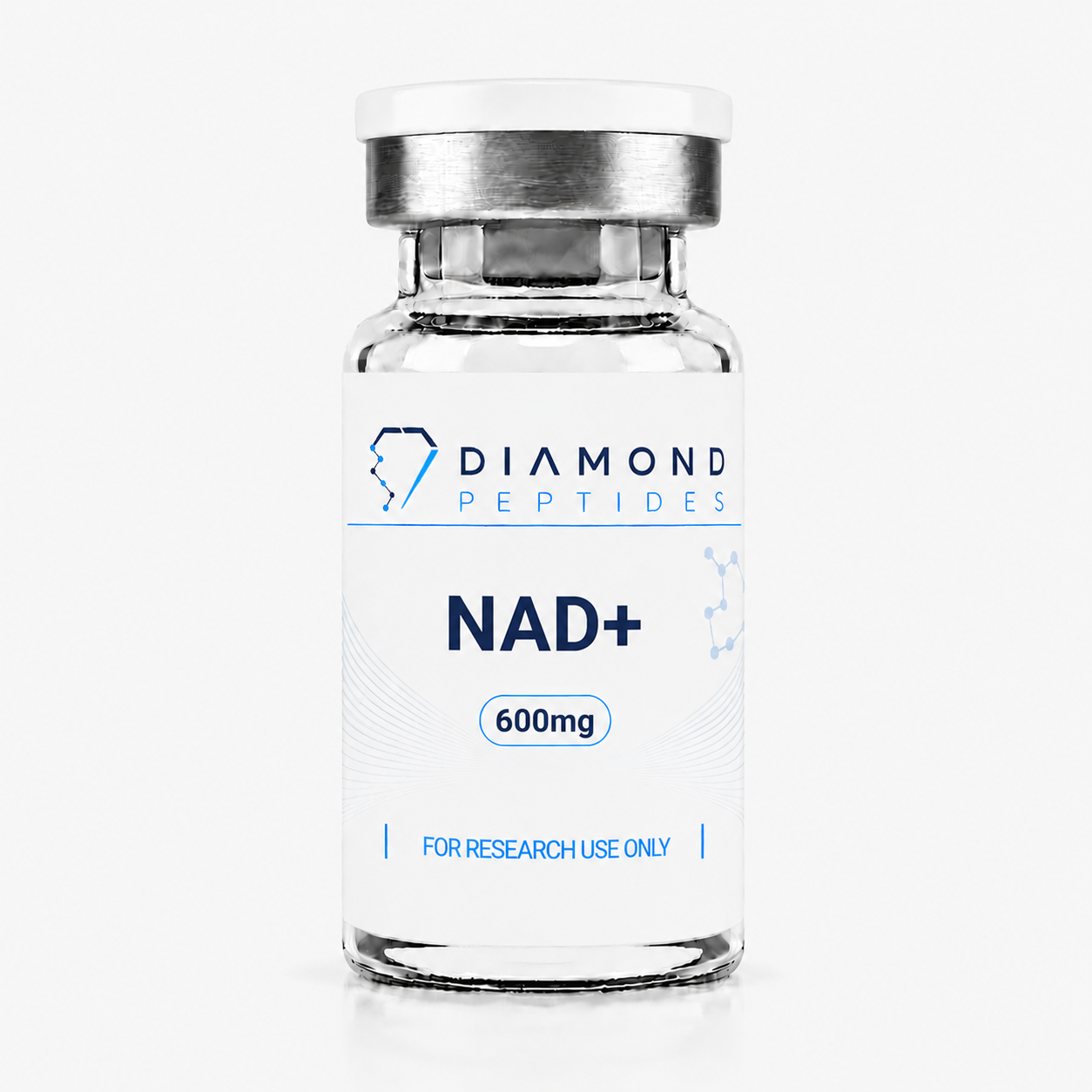
NAD+ (4-Pack)
NAD+ (4-Pack)
In stock
- Lab Tested for Purity & Quality
- Fast & Secure Shipping
- Manufactured in Canada
Couldn't load pickup availability
Product Details
- Form: Lyophilized free acid
- Net per vial: 600 mg (filled to approximately 104% of label)
- Purity: ≥99% (HPLC-verified)
- Identity: MS-verified (per COA)
- Storage: 2–8 °C, protect from light; long-term storage at −20 °C
- Formula / M.W.: C21H27N7O14P2 / 663.43 Da
- CAS: 53-84-9
What Makes NAD+ a Unique Compound
Nicotinamide adenine dinucleotide (NAD+) is a naturally occurring coenzyme that differs fundamentally from the peptides found throughout the Diamond Peptides catalogue. Rather than functioning as a signalling peptide, NAD+ serves as a critical metabolic cofactor required for hundreds of enzymatic reactions involved in cellular energy production, oxidation-reduction (redox) chemistry, and mitochondrial function. Its universal role across virtually every living cell has made it one of the most important molecules in modern biological research.
Scientific literature has extensively investigated NAD+ for its participation in cellular respiration, mitochondrial metabolism, glycolysis, oxidative phosphorylation, and ATP production. Beyond energy metabolism, NAD+ also functions as a substrate for numerous enzyme families—including sirtuins, PARPs, and CD38—that regulate cellular signalling, DNA repair, genomic stability, and stress responses. These diverse biological roles continue to make NAD+ a cornerstone of metabolism and longevity research.
Unlike many research compounds that target a single receptor or signalling pathway, NAD+ participates in multiple interconnected biological processes throughout the cell. This broad physiological importance allows researchers to investigate relationships between mitochondrial function, cellular aging, metabolic regulation, and redox homeostasis using a single well-characterized molecule.
For Canadian laboratories investigating metabolism, mitochondrial biology, and healthy aging, NAD+ provides a highly characterized research material supported by decades of scientific literature. Its central role in cellular physiology has established it as one of the most widely studied compounds in molecular biology and biomedical research.
Key Benefits
- Cellular Energy Metabolism — NAD+ is extensively investigated as an essential coenzyme involved in glycolysis, oxidative phosphorylation, mitochondrial respiration, and ATP production.
- Redox Biology Research — Scientific literature has widely explored NAD+ for its role as an electron carrier in oxidation-reduction reactions that maintain cellular metabolic homeostasis.
- Healthy Aging Research — Researchers continue to investigate NAD+ in studies involving sirtuins, PARPs, DNA repair pathways, and other biological mechanisms associated with cellular aging and longevity.
- Mitochondrial Function Research — NAD+ is frequently studied for its central role in mitochondrial biology, energy production, and cellular bioenergetics across numerous experimental models.
- Enzyme-Substrate Studies — As a substrate for sirtuins, PARPs, CD38, and other NAD+-consuming enzymes, NAD+ provides researchers with a valuable tool for investigating intracellular signalling and enzyme kinetics.
- Cellular Stress Response Research — Ongoing scientific studies continue to explore the relationship between NAD+ metabolism, oxidative stress, DNA damage responses, and cellular resilience under physiological stress.
Related Research Peptides
Researchers investigating NAD+ frequently study it alongside peptides involved in mitochondrial biology, metabolism, and healthy aging. Common companion research compounds include:
- MOTS-c — A mitochondrial-derived peptide extensively investigated for metabolic regulation, mitochondrial signalling, and cellular energy homeostasis, making it one of the most complementary compounds to NAD+ research.
- SS-31 — A mitochondria-targeting peptide widely studied for mitochondrial membrane function, bioenergetics, and oxidative stress, often paired with NAD+ in cellular metabolism research.
- Wolverine Stack — A proprietary combination of BPC-157 and TB-500 commonly investigated for tissue biology and regenerative research, complementing broader studies involving cellular repair mechanisms.
- Tesamorelin — A growth hormone-releasing hormone (GHRH) analogue frequently investigated in studies involving metabolism, body composition, and endocrine physiology, providing additional context for metabolic research.
Frequently Asked Questions
Where can I buy NAD+ in Canada for laboratory research?
Diamond Peptides supplies research-grade NAD+ exclusively for scientific and laboratory research throughout Canada. Every production batch undergoes High-Performance Liquid Chromatography (HPLC) purity verification, Mass Spectrometry (MS) identity confirmation, and is supported by batch-specific Certificates of Analysis (COAs).
Is NAD+ a peptide?
No. Nicotinamide adenine dinucleotide (NAD+) is a naturally occurring coenzyme rather than a peptide. It functions as an essential metabolic cofactor involved in cellular energy production, redox reactions, and numerous enzyme-mediated biological processes.
Is NAD+ naturally occurring?
Yes. NAD+ is present in virtually every living cell and is essential for normal cellular metabolism. The material supplied by Diamond Peptides is a highly purified, research-grade form intended exclusively for laboratory investigation.
How are purity and identity verified?
Every production batch is analyzed using High-Performance Liquid Chromatography (HPLC) to verify a purity of at least 99%, while Mass Spectrometry (MS) confirms molecular identity. Batch-specific Certificates of Analysis are provided to support laboratory quality assurance and research documentation.
⚠️ For research use only. Not intended for human or veterinary use. Not a drug, food, or supplement.