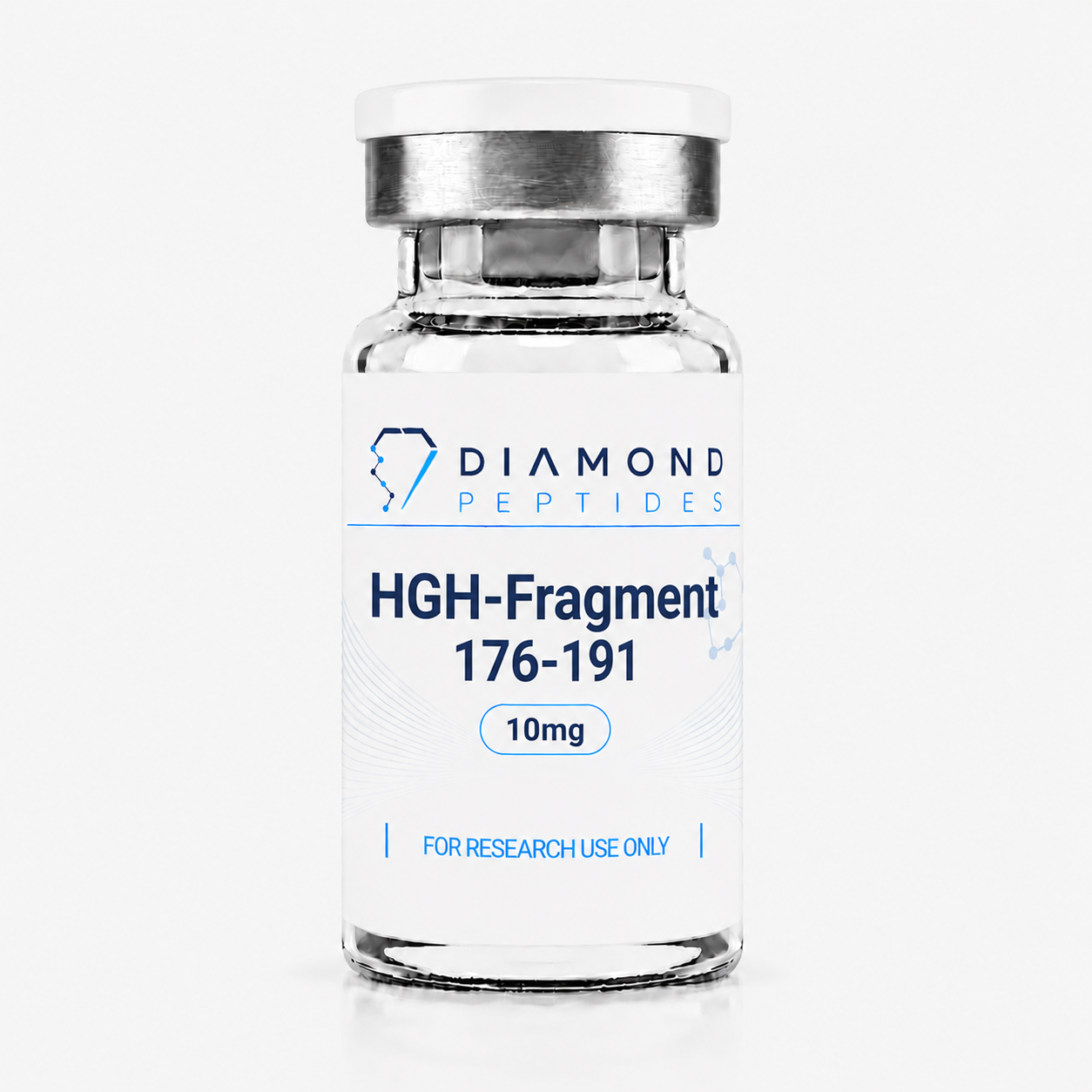
HGH Fragment 176-191 (4-Pack)
HGH Fragment 176-191 (4-Pack)
In stock
- Lab Tested for Purity & Quality
- Fast & Secure Shipping
- Manufactured in Canada
Couldn't load pickup availability
Buy HGH Fragment 176-191 in Canada | Research-Grade Lipid Metabolism Peptide
Diamond Peptides supplies premium-quality HGH Fragment 176-191 to universities, research laboratories, contract research organizations, and scientific institutions throughout Canada. Every vial contains research-grade lyophilized HGH Fragment 176-191 manufactured under rigorous quality standards and independently verified through High-Performance Liquid Chromatography (HPLC) purity testing together with Mass Spectrometry (MS) identity confirmation, providing researchers with reliable material for advanced metabolic and adipose tissue research.
HGH Fragment 176-191 is a synthetic peptide corresponding to the C-terminal amino acid sequence (residues 176–191) of human growth hormone. Unlike full-length growth hormone, this peptide is primarily investigated for its role in lipid metabolism and adipose tissue biology, allowing researchers to study a specific functional region of the growth hormone molecule independently. Supported by batch-specific Certificates of Analysis (COAs) and dependable Canadian inventory, Diamond Peptides provides laboratories with a trusted source of high-purity HGH Fragment 176-191 for scientific investigation.
Product Details
- Form: Lyophilized peptide
- Net per vial: 10 mg (filled to approximately 104% of label)
- Purity: ≥99% (HPLC-verified)
- Identity: MS-verified (per COA)
- Storage: 2–8 °C, protect from light
- Formula / M.W.: C78H125N23O23S2 / 1817.12 Da
- CAS: 221231-10-3
What Makes HGH Fragment 176-191 a Unique Compound
HGH Fragment 176-191 is a synthetic peptide consisting of the final sixteen amino acids from the C-terminal region of the human growth hormone molecule. Rather than replicating the broad physiological effects of full-length growth hormone, this peptide was developed to enable researchers to investigate the biological activity associated with one specific region of the protein. Its focused design has made it an important research tool within metabolic and adipose tissue biology.
Scientific literature has extensively investigated HGH Fragment 176-191 for its relationship with lipid metabolism, adipocyte biology, and fat metabolism pathways. Because the peptide represents only a defined segment of the parent hormone, researchers can examine its biological activity independently without studying the complete spectrum of growth hormone signalling. This targeted approach provides valuable insight into the molecular mechanisms involved in metabolic regulation.
Unlike Tesamorelin, which functions as a growth hormone-releasing hormone (GHRH) analogue and acts upstream by stimulating endogenous growth hormone release, HGH Fragment 176-191 is studied directly as a discrete growth hormone fragment. This distinction makes it a valuable comparative research compound for laboratories investigating different mechanisms involved in metabolism and endocrine physiology.
For Canadian laboratories investigating obesity research, adipose tissue biology, and metabolic regulation, HGH Fragment 176-191 provides a well-characterized research peptide supported by decades of scientific investigation. Its highly specific structure continues to make it one of the most recognized growth hormone-derived fragments in metabolic research.
Key Benefits
- Lipid Metabolism Research — HGH Fragment 176-191 is extensively investigated in laboratory models examining lipid metabolism, adipocyte biology, and fat metabolism pathways.
- Adipose Tissue Research — Scientific literature has explored the peptide for its relationship with biological mechanisms involved in adipose tissue function and metabolic regulation.
- Growth Hormone Fragment Research — Researchers frequently investigate HGH Fragment 176-191 as a defined region of the human growth hormone molecule to better understand the contribution of individual peptide domains.
- Metabolic Physiology Research — Researchers continue to investigate HGH Fragment 176-191 in experimental models examining metabolic regulation, energy balance, and adipose tissue physiology.
- Comparative Metabolic Research — HGH Fragment 176-191 is commonly studied alongside compounds such as Tesamorelin, Retatrutide, and MOTS-c to compare distinct biological mechanisms involved in metabolism and endocrine physiology.
- Endocrine Biology Research — Ongoing scientific investigations continue to explore the relationship between growth hormone-derived peptides, lipid metabolism, and metabolic signalling pathways.
Related Research Peptides
Researchers investigating HGH Fragment 176-191 frequently study it alongside other compounds involved in metabolism, mitochondrial biology, and endocrine physiology. Common companion research compounds include:
- Tesamorelin — A growth hormone-releasing hormone (GHRH) analogue extensively investigated for growth hormone regulation, metabolism, and endocrine signalling, providing a complementary upstream mechanism to HGH Fragment 176-191.
- Retatrutide — A next-generation multi-receptor peptide widely investigated for metabolic regulation, energy homeostasis, and obesity research, making it a valuable companion compound in metabolic studies.
- MOTS-c — A mitochondrial-derived peptide commonly studied for mitochondrial signalling, AMPK activation, and cellular energy metabolism, complementing broader investigations into metabolic physiology.
- NAD+ — A naturally occurring metabolic coenzyme extensively researched for cellular bioenergetics, redox biology, and mitochondrial function, providing additional context for metabolism-focused research.
Frequently Asked Questions
Where can I buy HGH Fragment 176-191 in Canada for laboratory research?
Diamond Peptides supplies research-grade HGH Fragment 176-191 exclusively for scientific and laboratory research throughout Canada. Every production batch undergoes High-Performance Liquid Chromatography (HPLC) purity verification, Mass Spectrometry (MS) identity confirmation, and is supported by batch-specific Certificates of Analysis (COAs).
How is HGH Fragment 176-191 different from Tesamorelin?
Although both compounds are investigated in metabolic research, they act through different biological mechanisms. HGH Fragment 176-191 is a synthetic fragment derived from the human growth hormone molecule and is studied directly for its relationship with lipid metabolism, whereas Tesamorelin is a GHRH analogue investigated for stimulating endogenous growth hormone signalling.
Is HGH Fragment 176-191 naturally occurring?
No. While the amino acid sequence corresponds to the C-terminal region of naturally occurring human growth hormone, the material supplied by Diamond Peptides is a synthetic peptide produced specifically for laboratory research.
How are purity and identity verified?
Every production batch is analyzed using High-Performance Liquid Chromatography (HPLC) to verify a purity of at least 99%, while Mass Spectrometry (MS) confirms molecular identity. Batch-specific Certificates of Analysis are provided to support laboratory quality assurance and research documentation.
⚠️ For research use only. Not intended for human or veterinary use. Not a drug, food, or supplement.